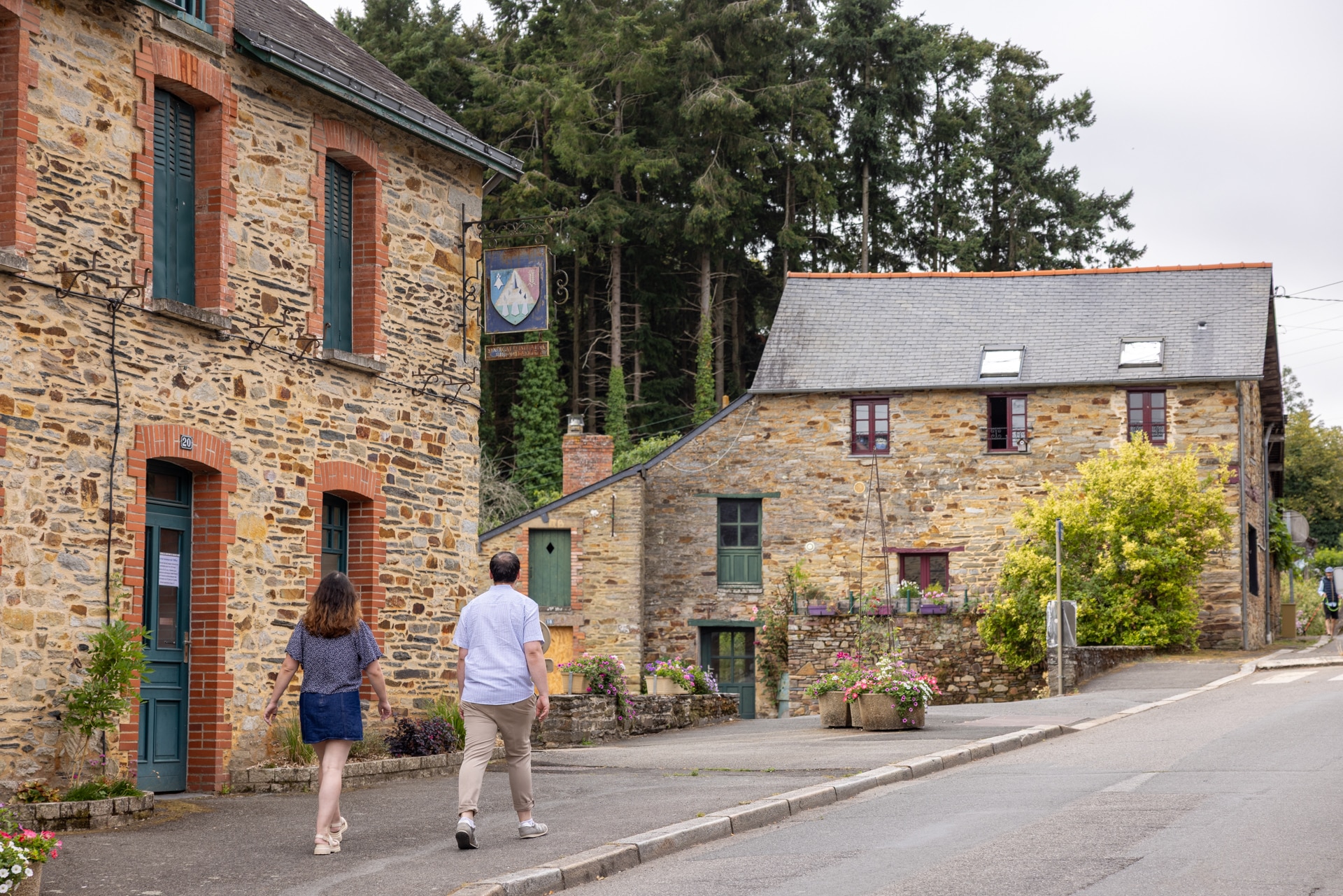
Langon, a pretty Breton village classified as a Commune du Patrimoine Rural de Bretagne, nestles on the peaceful banks of the Vilaine River. Inhabited since prehistoric times, the area boasts a fascinating millennial heritage, marked by the Gallo-Roman era, the Middle Ages and the Industrial Revolution.
a village
a thousand stories
From its Gallo-Roman origins to the Middle Ages, Langon has preserved the traces of its rich past. Long ago, a wealthy Gallo-Roman landowner decided to settle here, on the banks of a wide river and close to a Roman road.
Its heritage bears witness to a thousand years of history, dating back to the Mesolithic period:


- In a quiet hamlet high above the village, in a small pine forest, stand proud white quartz menhirs: the Demoiselles de Langona testimony to prehistory.
- In Gallo-Roman times, the site of today’s Sainte-Agathe chapel (listed as a Monument Historique) housed thermal baths. In 1840, a fresco of Venus was found on the interior walls. It depicts an aquatic scene, a Venus and Cupid. This fresco is considered exceptional. The chapel’s role did not end there. During the High Middle Ages, it was used as a church, then as a funeral chapel. Ask at the town hall if you’d like to visit this curiosity (02 99 08 76 55).
- Opening hours:
- A Roman road, which follows the Vilaine, bears witness to an ancient paved road. This is also known as the Chemin de la Duchesse Anne. The Roman road is still visible and well preserved. It lies between Langon and Beslé-sur-Vilaine.
- Spanning the Vilaine River, the Port de Roche bridge is a metal structure dating from 1868. On the pillars, the letters “E” and “N” evoke Emperor Napoleon III and his wife, Empress Eugénie, rulers of France during the Second Empire.

ALONG THE VILAINE
disconnection and nature
The Vilaine valley invites every walker to immerse themselves in an ocean of greenery, where every step echoes in hushed calm. Following the V42 or Traversée bretonne in the direction of Guipry-Messac will take you straight to the Corbinières viaduct. Built in 1861, this viaduct links the two banks of the river, and now provides rail links to Redon and Rennes.
A number of hiking trails will satisfy the more athletic: the towpath allows walkers to marvel at the wild landscapes of the Vilaine Valley. Bicycle trails are also available.
traditions
& local life
With such a rich and fascinating history, Langon is a place where many events take place. During the European Heritage Days or other special events, you can visit the Sainte-Agathe chapel. And don’t hesitate to push open the doors of the church (if closed, ask at the Mairie).
Every Tuesday late afternoon, the Langon market (place de l’église) is in full swing with a host of local producers.
Along the way, numerous art galleries open their doors to you. And every year, the Bordures festival celebrates all types of music.

Did you know?
The church of Saint-Pierre and Saint-Paul was rebuilt in stone during the Middle Ages after being burnt down by the Vikings. One striking architectural detail is its bell towers. That’s right! Twelve belfry bells dot the steeple. They depict Christ in glory, surrounded by his twelve apostles.
The church of Saint-Pierre and Saint-Paul is listed as a Monument Historique.

access & transport
Car – Train – Boat – Bike
You can reach Langon by car from the D177, by train from the Rennes – Redon line, by boat from the Port de Roche boat stop, and by bike from the V42 or the Traversée Bretonne.

to see, to do
- Les Demoiselles de Langon
- The village
- Saint-Pierre and Saint-Paul church
- Sainte-Agathe chapel
- The wash-house behind the town hall
- Roche harbour and bridge
- The Corbinières viaduct
- The Roman road